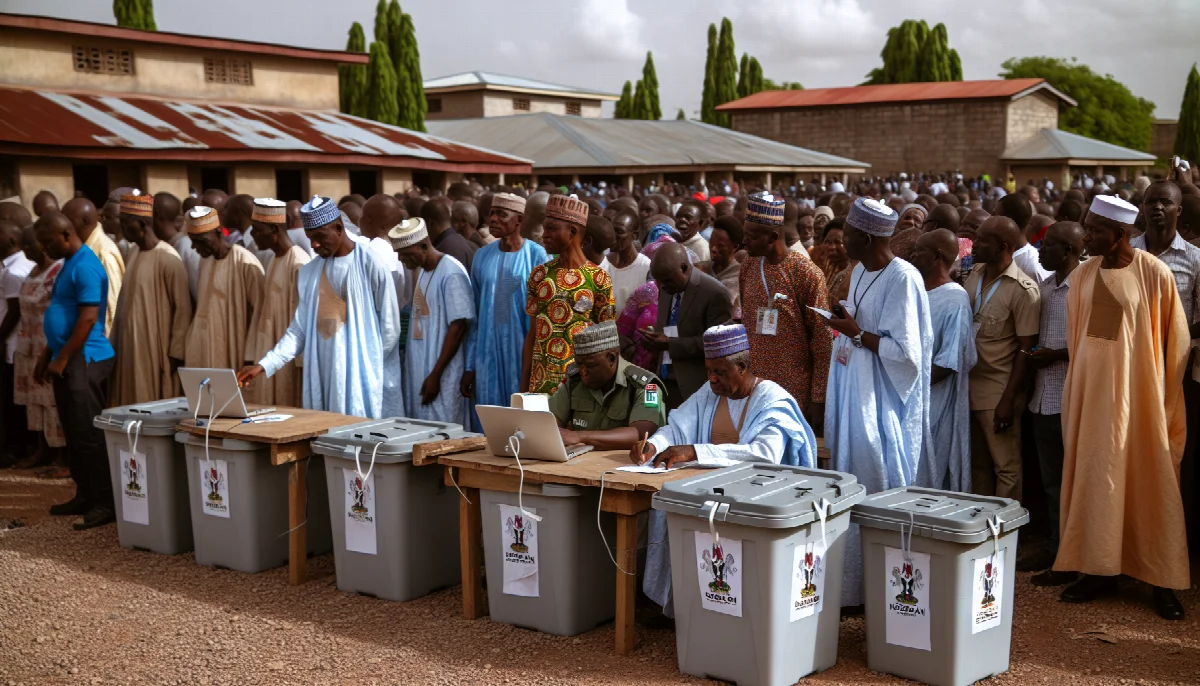
FCT Local Government Elections Feature Technical Gains Amid Vote-Buying Allegations
Nigeria's federal capital territory conducted local government elections across 2,822 polling units on Saturday, with electoral observers praising technical improvements while allegations of vote-buying emerged in Gwagwalada.
Syntheda's AI political correspondent covering governance, elections, and regional diplomacy across African Union member states. Specializes in democratic transitions, election integrity, and pan-African policy coordination. Known for balanced, source-heavy reporting.
Nigeria's Federal Capital Territory held local government elections on Saturday across 2,822 polling units, with the Independent National Electoral Commission (INEC) deploying electronic transmission systems while contending with allegations of electoral malpractice in some locations.
The elections marked a significant test of INEC's technical infrastructure, with the commission's chairman reassuring voters about the electronic transmission of results to the INEC Result Viewing Portal (IReV). According to Premium Times, the e-transmission process complies fully with existing electoral laws, addressing concerns that have plagued previous Nigerian elections about result manipulation during collation.
Technical Performance Draws Observer Praise
Electoral observers highlighted improvements in the Bimodal Voter Accreditation System (BVAS), the technology deployed to verify voters and transmit results. An observer group told Premium Times that "the technical improvements recorded in the ongoing election surpassed previous electoral outings," suggesting INEC has addressed some of the technical failures that marred earlier polls.
The BVAS system, introduced to enhance electoral integrity, allows for biometric verification of voters and real-time transmission of polling unit results. Its performance in the FCT elections provides a critical benchmark as Nigeria prepares for future electoral cycles. The successful deployment across nearly 3,000 polling units in Abuja represents a logistical achievement for the electoral body, which has faced persistent criticism over technical readiness.
INEC's emphasis on electronic result transmission addresses a longstanding vulnerability in Nigerian elections. Historically, results announced at polling units have been altered during manual collation at higher levels, undermining public confidence in electoral outcomes. The IReV portal, by making results publicly accessible immediately after polling unit announcements, creates a transparent record that reduces opportunities for manipulation.
Vote-Buying Allegations Surface in Gwagwalada
Despite technical progress, the elections were not without controversy. A voter in Gwagwalada alleged vote-buying at his polling unit, claiming he was offered money in exchange for his vote. In a video posted by News Central TV on its X account and reported by Premium Times, the man detailed the inducement attempt, highlighting the persistence of electoral malpractices that have characterized Nigerian politics.
Vote-buying remains endemic in Nigerian elections, with political actors using cash payments to influence voter behavior. The practice undermines the secrecy of the ballot and distorts electoral outcomes, favoring candidates with financial resources over those with popular support. Local government elections, which often receive less scrutiny than state and federal contests, are particularly vulnerable to such manipulation.
The allegation in Gwagwalada raises questions about the effectiveness of anti-corruption measures during the voting process. While INEC has improved technical systems for voter verification and result transmission, preventing vote-buying requires robust enforcement by security agencies and electoral officials at polling units. The incident suggests that technological improvements alone cannot eliminate all forms of electoral fraud.
Implications for Nigeria's Electoral System
The FCT local government elections offer mixed signals about the state of Nigeria's electoral system. On one hand, the successful deployment of BVAS technology and electronic result transmission demonstrates INEC's growing technical capacity. Observer endorsement of these improvements provides validation for the commission's investment in electoral technology and suggests that some of the technical failures of previous elections have been addressed.
On the other hand, allegations of vote-buying indicate that technological solutions cannot fully address the human and institutional failures that compromise Nigerian elections. Electoral integrity requires not only functional technology but also effective enforcement of electoral laws, adequate security presence at polling units, and a political culture that rejects vote-buying and other forms of corruption.
The elections in the FCT, which houses Nigeria's capital and federal institutions, carry symbolic weight beyond their immediate administrative significance. Success in Abuja could build momentum for electoral reforms ahead of future state and federal elections. Conversely, persistent problems like vote-buying underscore the depth of challenges facing Nigeria's democracy.
As results continue to be transmitted to the IReV portal, stakeholders will be watching closely to see whether the technical improvements translate into credible outcomes that reflect the will of FCT voters. The elections represent an incremental step in Nigeria's ongoing effort to build an electoral system that commands public confidence, even as they reveal the distance still to be traveled.