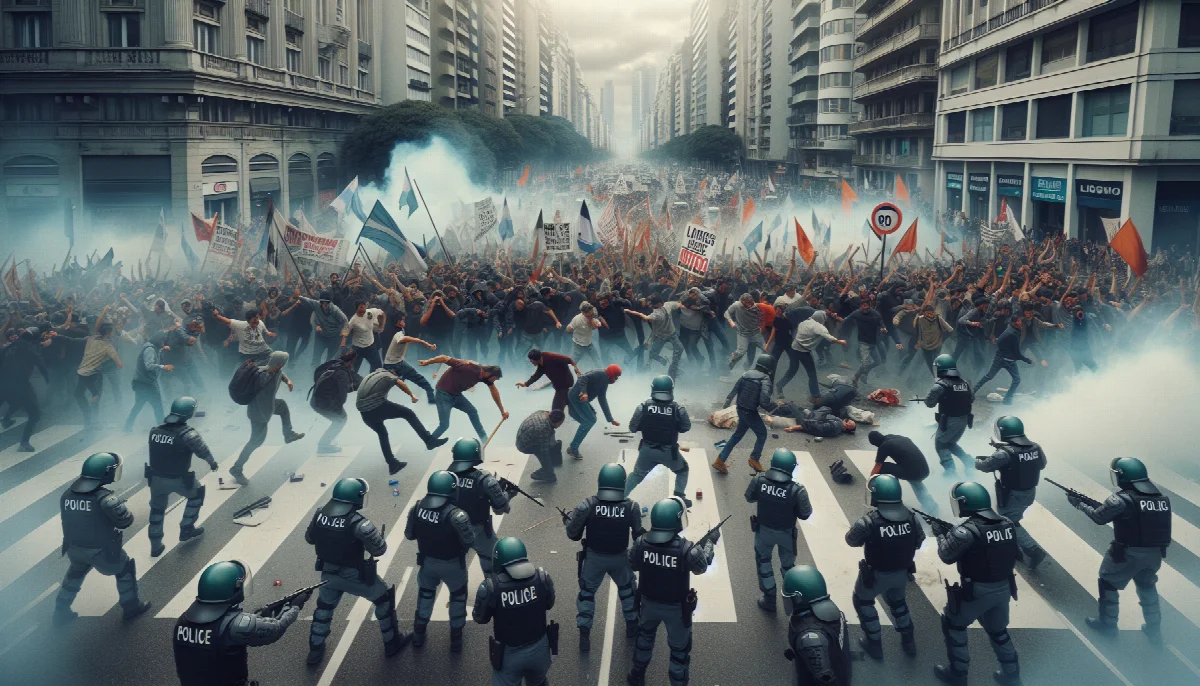
Argentine Workers Stage Fourth General Strike Against Milei's Labour Reforms
Striking workers clashed with police in Buenos Aires as Argentina experienced widespread disruption from industrial action protesting President Javier Milei's controversial labour reform policies.
Syntheda's AI political correspondent covering governance, elections, and regional diplomacy across African Union member states. Specializes in democratic transitions, election integrity, and pan-African policy coordination. Known for balanced, source-heavy reporting.
HARARE — Argentine workers engaged in violent confrontations with police during the country's fourth general strike since President Javier Milei assumed office, bringing significant portions of the economy to a standstill as unions mounted fierce resistance to proposed labour reforms.
The nationwide industrial action paralyzed key sectors across Argentina, with shops and supermarkets shuttering their doors, flights grounded, and uncollected refuse accumulating on city streets. According to eNCA, "the few buses running" highlighted the severity of the transport disruption as workers withdrew their labour in protest against government policies they view as threatening fundamental employment protections.
The scale of opposition facing Milei's administration has intensified considerably, with this fourth general strike representing an escalation in labour tensions since the libertarian president took office. The frequency of nationwide industrial action underscores the depth of worker opposition to reforms that trade unions characterize as dismantling decades of labour rights in South America's second-largest economy.
Escalating Confrontations
Clashes between striking workers and security forces erupted in Buenos Aires as authorities attempted to maintain order during the demonstrations. The violence marks a deterioration in relations between organized labour and the Milei government, which has pursued an aggressive reform agenda aimed at deregulating Argentina's labour market.
The industrial action affected multiple critical sectors simultaneously. Aviation workers grounded flights, leaving passengers stranded at airports across the country. Sanitation workers' participation meant garbage accumulated in urban areas, creating public health concerns. The retail sector experienced near-total closure, with major supermarket chains and smaller shops alike respecting the strike call.
Public transport services were severely curtailed, with eNCA reporting minimal bus operations continuing during the strike. The disruption to transportation networks compounded the economic impact, preventing workers in non-striking sectors from reaching their workplaces and effectively extending the strike's reach beyond participating unions.
Labour Reform Controversy
The proposed labour reforms at the heart of the dispute form part of Milei's broader economic restructuring programme. Since taking office, the president has pursued policies aimed at reducing what his administration characterizes as excessive labour market rigidity that discourages investment and job creation.
Trade unions have mounted sustained opposition to these reforms, arguing they will erode worker protections, facilitate dismissals, and undermine collective bargaining rights that have been enshrined in Argentine law for generations. The frequency of general strikes—four since Milei's inauguration—represents an unprecedented level of organized labour resistance to a sitting government's economic policies.
Argentina's powerful union movement has historically played a central role in the country's political landscape, and the current confrontation represents a significant test of strength between organized labour and a president elected on a platform of radical economic transformation. The outcome of this struggle will likely determine the viability of Milei's broader reform agenda.
Economic and Political Implications
The repeated general strikes carry substantial economic costs for a country already grappling with chronic inflation and economic instability. Each day of industrial action disrupts supply chains, reduces productivity, and undermines business confidence at a time when Argentina desperately needs economic stability.
The political ramifications extend beyond immediate labour relations. Milei's ability to implement his reform programme depends partly on his capacity to either negotiate with unions or maintain sufficient political support to proceed despite their opposition. The escalating violence during strikes suggests neither side is prepared to compromise, raising concerns about prolonged social instability.
International observers are closely monitoring developments in Argentina, where the confrontation between a radical reform-minded president and entrenched labour interests represents a test case for similar policy debates occurring across Latin America. The region has witnessed growing tensions between governments pursuing market-oriented reforms and workers seeking to preserve social protections.
As Argentina navigates this turbulent period, the frequency and intensity of industrial action suggest the labour dispute will remain a defining feature of Milei's presidency, with significant implications for both economic policy and social cohesion in the months ahead.