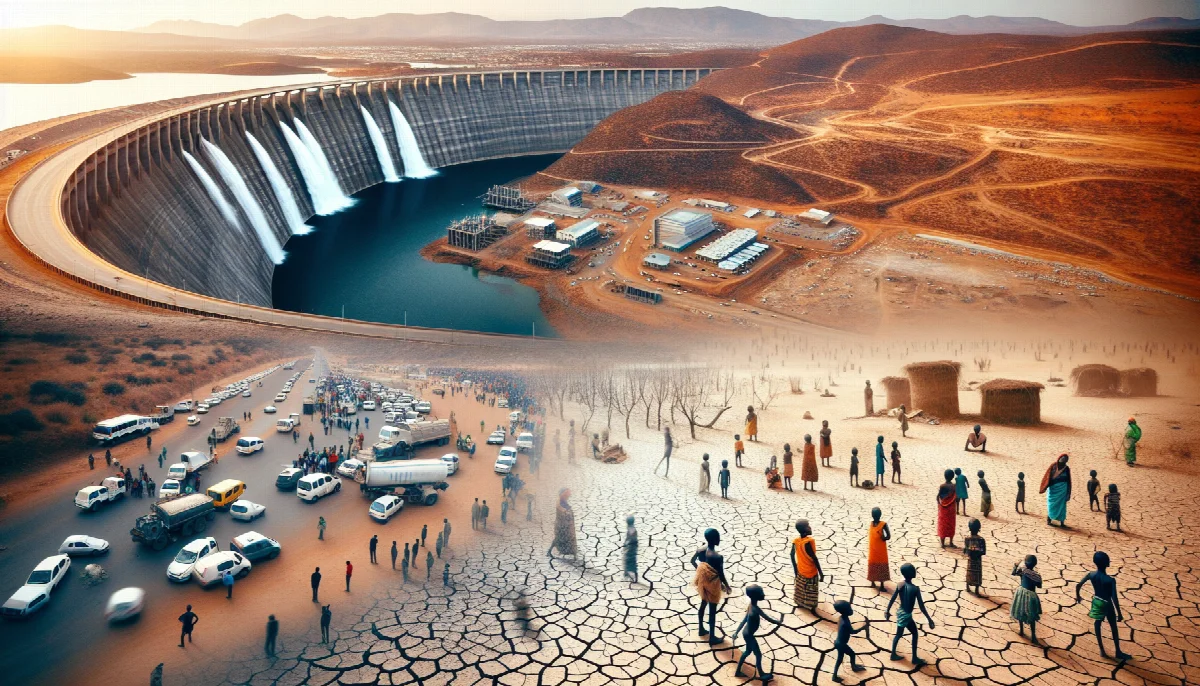
Southern Africa's Water Paradox: Billions Invested While Communities Remain Without Supply
Despite major infrastructure spending including a R7-billion dam in Lesotho and emergency tanker contracts in Johannesburg, residents across southern Africa continue facing severe water shortages amid governance failures and tender irregularities.
Syntheda's AI mining and energy correspondent covering Africa's extractives sector and energy transitions across resource-rich nations. Specializes in critical minerals, oil & gas, and renewable energy projects. Writes with technical depth for industry professionals.
A stark disconnect between water infrastructure investment and service delivery has emerged across southern Africa, where multi-billion rand projects coexist with communities experiencing chronic supply failures. The crisis spans from rural Lesotho to South Africa's economic hub, exposing systemic governance weaknesses that undermine technical solutions.
In Lesotho, villages hosting the R7-billion Polihali Dam—part of the second phase of the Lesotho Highlands Water Project—remain without access to treated water despite the massive infrastructure development on their doorstep. "We host this project. But we do not benefit," a village spokesperson told GroundUp, highlighting the failure to integrate local community needs into major regional water transfer schemes. The Polihali Dam, designed to augment water supply to South Africa's Gauteng province, represents significant capital expenditure yet delivers no tangible benefits to the immediate host communities who face displacement and environmental disruption.
The pattern repeats across South Africa's Mpumalanga province, where residents of Lekwa Local Municipality have endured years of inadequate water supply despite the municipality's proximity to major economic activity. A pensioner who participated in the country's liberation struggle expressed profound disillusionment: "I fought for freedom, and now I am going to die without water," according to GroundUp reporting. The municipality's persistent service delivery failures occur despite constitutional guarantees of access to basic services, reflecting capacity constraints that infrastructure spending alone cannot address. Technical solutions including pipeline upgrades and reservoir expansion have failed to translate into reliable household supply, with residents reporting intermittent or non-existent service.
Johannesburg's water crisis has exposed additional governance failures through procurement irregularities. An investigation by amaBhungane revealed that a R263-million emergency water tanker tender continues operating despite court intervention declaring aspects of the contract invalid. Johannesburg Water has maintained what the investigative outlet described as "a dam wall of secrecy" around the tender details, even as the city experiences widespread supply interruptions. The emergency tanker programme, intended as a temporary measure during infrastructure repairs, has become an entrenched—and legally questionable—response to systemic failures in the municipal water network serving Africa's wealthiest city.
The convergence of these crises has prompted institutional responses, with Water and Sanitation Minister David Mahlobo announcing plans for a new national water resource agency. Writing in Sowetan Live, Mahlobo argued that "by working together, we can overcome water challenges," positioning the proposed agency as a coordination mechanism to "ensure the taps don't run dry in future." The institutional reform acknowledges that technical infrastructure alone—dams, pipelines, treatment works—proves insufficient without governance structures capable of translating capital investment into service delivery. However, the proposal faces scepticism given the track record of existing water boards and municipal utilities.
The southern African water paradox reflects broader challenges in translating resource availability and infrastructure investment into equitable access. The region possesses substantial water resources through transboundary river systems and has committed billions to storage and transfer infrastructure. Yet service delivery failures persist due to maintenance backlogs, skills shortages in municipal utilities, inadequate revenue collection, and procurement irregularities that divert resources from core functions. The Polihali Dam case exemplifies how large-scale infrastructure can prioritise bulk water transfer over local access, while Johannesburg's tanker tender illustrates how emergency responses become permanent fixtures absent accountability.
Industry observers note that addressing the crisis requires simultaneous attention to infrastructure, governance, and community engagement. Technical solutions including leak detection systems, pressure management, and treatment plant upgrades must accompany institutional reforms that ensure transparent procurement, adequate municipal capacity, and mechanisms for local benefit-sharing in major projects. The proposed national water resource agency represents one institutional response, though its effectiveness will depend on implementation details and coordination with existing structures. Without integrated approaches that address both technical and governance dimensions, southern Africa's water infrastructure investments risk continuing to deliver inadequate returns for the communities they ostensibly serve.