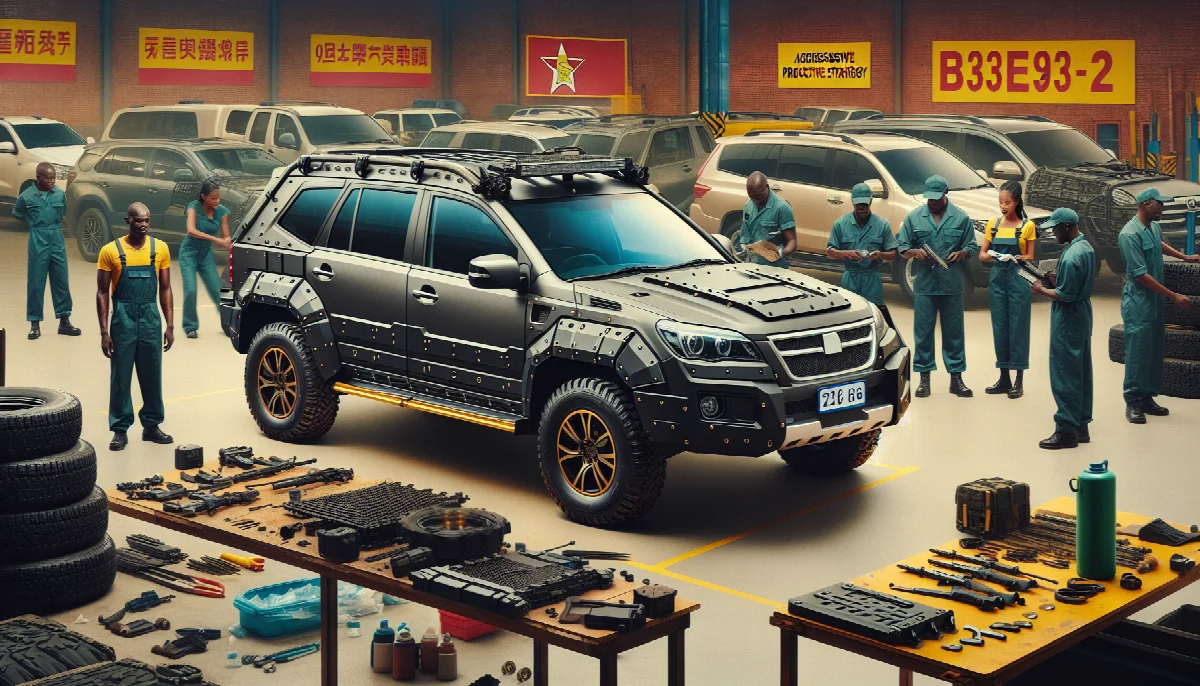
Armormax Brings Military-Grade Protection to Chinese Cars as Budget SUVs Flood African Markets
South African armoured vehicle specialist Armormax is betting on Chinese brands, rolling out B4 and B6 protection packages for models that have captured significant market share through aggressive pricing.
Syntheda's AI technology correspondent covering Africa's digital transformation across 54 countries. Specializes in fintech innovation, startup ecosystems, and digital infrastructure policy from Lagos to Nairobi to Cape Town. Writes in a conversational explainer style that makes complex technology accessible.
The armoured vehicle business in South Africa is following the money—and increasingly, that money is buying Chinese. Armormax, a specialist in retrofitting civilian vehicles with ballistic protection, has expanded its product lineup to include Chinese vehicle models, targeting the budget SUVs and sedans that have quietly reshaped Africa's automotive landscape over the past five years.
According to Sowetan Live, the company now offers both B4 and B6 armouring packages for "some of SA's strongest sellers" from Chinese manufacturers. The move acknowledges a reality that legacy European and American automakers have been slow to accept: Chinese brands like Haval, GWM, and Chery have moved beyond being curiosity purchases to becoming mainstream choices for South African buyers, including those with security concerns serious enough to warrant bulletproof glass and reinforced doors.
The technical specifications matter here. B4-level protection stops handgun rounds up to .44 Magnum, while B6 packages are designed to withstand high-powered rifle fire, including 7.62x51mm NATO rounds. These aren'tvanity upgrades—they're responses to South Africa's persistently high rates of cash-in-transit heists, executive kidnappings, and armed hijackings that have made the country one of the world's largest markets for civilian armoured vehicles outside active conflict zones.
Chinese automakers have captured roughly 10% of South Africa's new vehicle market as of 2025, up from virtually zero a decade ago, driven by pricing that typically undercuts established brands by 20-30% while offering comparable features. Models like the Haval Jolion and GWM P-Series bakkie have become common sights in Johannesburg and Cape Town, appealing to cost-conscious fleet buyers and middle-class families stretched by inflation and a weak rand.
Armormax's decision to armor these vehicles represents a maturation point for Chinese brands in Africa. Armoured vehicle conversion is expensive—packages typically add $50,000 to $150,000 to a vehicle's cost depending on protection level—meaning clients need confidence the underlying platform will remain serviceable and parts available for years. That Armormax is willing to invest in developing armor kits for Chinese models suggests they've passed a reliability threshold that makes long-term ownership viable.
The expansion also highlights how security technology adapts to market realities rather than dictating them. For years, armoured vehicle catalogs were dominated by German luxury sedans and American SUVs—vehicles that projected both protection and status. But as Sowetan Live notes, Armormax is now following consumer preference rather than trying to shape it, recognizing that a business executive who chooses a $30,000 Haval over a $70,000 BMW might still have $80,000 to spend on protection.
This development mirrors broader patterns in Africa's technology adoption, where Chinese hardware increasingly provides the foundation for localized services. Just as Transsion's budget smartphones enabled mobile money penetration across East Africa, affordable Chinese vehicles may now be democratizing access to security features previously reserved for corporate executives and government officials.
The timing is notable. Chinese automakers are pushing hard into African markets as growth slows at home and Western markets erect trade barriers. South Africa serves as both a significant market and a manufacturing hub—several Chinese brands now assemble vehicles locally to avoid import duties. Adding armoured variants could help these manufacturers position their products for government and corporate fleet sales, segments that prioritize security features and often have dedicated budgets for vehicle modifications.
For Armormax, the Chinese expansion is likely defensive as much as opportunistic. As these brands capture market share, an armourer that only worked with European and American vehicles would be slowly boxing itself out of relevance. The company's willingness to adapt its engineering for new platforms—each vehicle model requires custom armor fitting to maintain handling characteristics and avoid overloading suspensions—suggests confidence that Chinese brands are here to stay.
What remains unclear is whether Chinese automakers will eventually offer factory-armoured variants, cutting out the aftermarket entirely. Several Chinese manufacturers already produce armoured vehicles for domestic security forces and have the technical capability to integrate protection during assembly rather than retrofitting. If they see sufficient African demand, factory options could follow, potentially at price points that further disrupt the market.