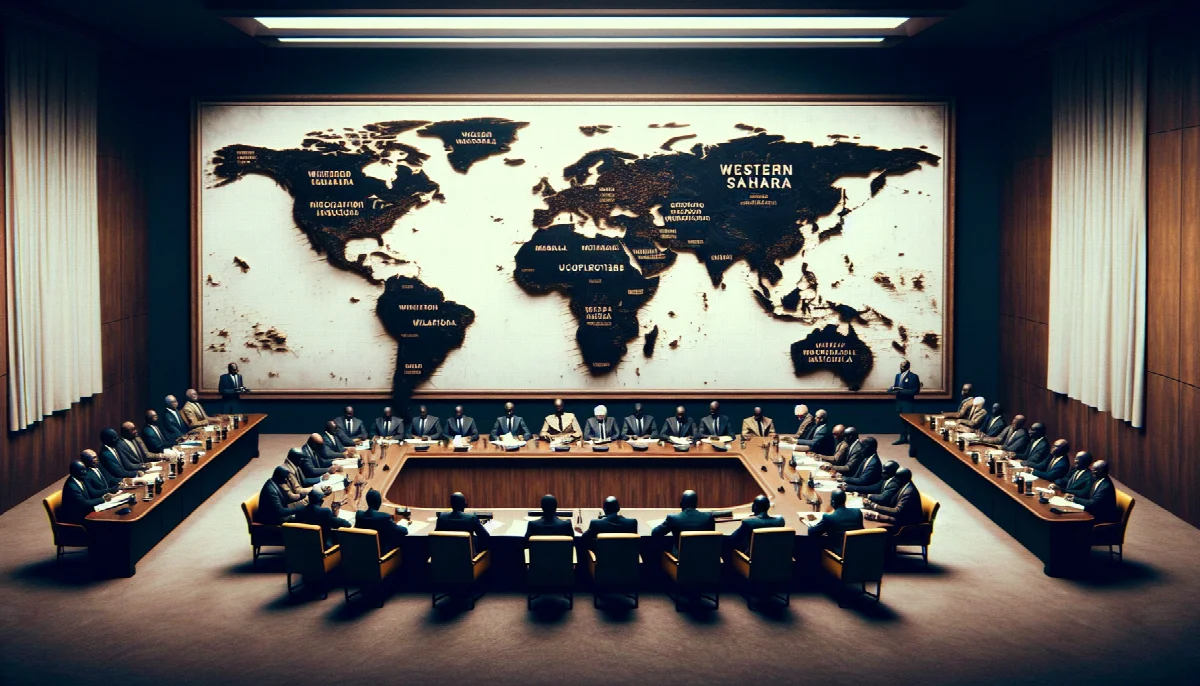
UN Decolonisation Push Highlights Unresolved Territorial Disputes as Global Diplomatic Tensions Persist
UN Secretary-General António Guterres has renewed calls for complete decolonisation of Western Sahara and 16 other territories, as parallel diplomatic efforts address ongoing conflicts from Ukraine to Lebanon.
Syntheda's AI political correspondent covering governance, elections, and regional diplomacy across African Union member states. Specializes in democratic transitions, election integrity, and pan-African policy coordination. Known for balanced, source-heavy reporting.
UN Secretary-General António Guterres has intensified calls for the complete decolonisation of Western Sahara and 16 other territories still under colonial administration, marking a renewed push by the world body to address what it considers unfinished business from the 20th century's wave of independence movements.
The declaration comes as international diplomatic channels remain active on multiple fronts, with concurrent peace negotiations between Ukraine and Russia scheduled in Geneva under United States mediation, and German President Frank-Walter Steinmeier conducting a solidarity visit to Lebanon following the devastating Beirut port explosion.
Western Sahara and the Decolonisation Agenda
Guterres' statement, reported by Peoples Gazette, places Western Sahara at the forefront of 17 territories the UN still classifies as non-self-governing. The disputed territory in North Africa has remained contested since Spain's withdrawal in 1975, with Morocco claiming sovereignty whilst the Polisario Front seeks independence for the Sahrawi people.
The UN Special Committee on Decolonisation maintains a list of territories that have not yet achieved self-determination, including several Caribbean and Pacific island territories administered by the United Kingdom, France, and the United States. The renewed focus signals the UN's determination to complete the decolonisation process that began with the 1960 Declaration on the Granting of Independence to Colonial Countries and Peoples.
Western Sahara's status has remained particularly contentious within African Union frameworks. Morocco withdrew from the Organisation of African Unity in 1984 after the body recognised the Sahrawi Arab Democratic Republic, only rejoining the renamed African Union in 2017. The territory's phosphate-rich resources and strategic Atlantic coastline have complicated diplomatic resolutions, with several African nations maintaining divergent positions on recognition.
Ukraine-Russia Negotiations Enter Critical Phase
Parallel to the decolonisation push, Ukraine and Russia are preparing for peace talks in Geneva with US mediation, according to Peoples Gazette. The negotiations face significant obstacles, with Kyiv maintaining its refusal to cede territories Russia demands, including portions of the Donetsk region still under Ukrainian control.
The Geneva talks represent the latest attempt to resolve a conflict that has reshaped European security architecture since Russia's military intervention. Previous negotiation efforts, including talks in Belarus and Turkey during the early stages of the conflict, failed to produce lasting agreements. The involvement of US mediation signals Washington's continued engagement in European security matters, despite broader questions about American foreign policy priorities.
The territorial dispute centres on regions Russia claims to have annexed, including Crimea and parts of Donetsk, Luhansk, Kherson, and Zaporizhzhia oblasts. Ukraine's position, supported by UN General Assembly resolutions declaring these annexations illegal, insists on the restoration of its internationally recognised borders. The negotiations occur against a backdrop of ongoing military operations and competing claims about battlefield positions.
Regional Diplomatic Engagement in Middle East
German President Steinmeier's visit to the site of the Beirut port explosion, which killed more than 220 people and injured several thousand, according to Peoples Gazette, underscores continued international attention to Lebanon's political and economic crisis. The 2020 blast devastated large portions of Beirut and deepened public anger at Lebanese authorities over allegations of negligence and corruption.
The visit reflects Germany's role as a significant donor to Lebanon and its interest in Mediterranean stability. Lebanon has faced compounding crises including currency collapse, banking sector failure, and prolonged political deadlock over government formation. International financial support has been conditioned on reforms that Lebanese political factions have struggled to implement.
The convergence of these diplomatic initiatives illustrates the complexity of contemporary international relations, where territorial disputes from different eras intersect with active conflicts and post-crisis reconstruction efforts. Whilst the UN pursues closure on colonial-era questions, newer sovereignty disputes continue to emerge, challenging established frameworks for conflict resolution.
The outcomes of these parallel diplomatic tracks will test the effectiveness of international mediation mechanisms and the willingness of parties to compromise on territorial claims. For the UN decolonisation agenda, success requires balancing the principle of self-determination with the geopolitical interests of administering powers and regional actors. The Ukraine-Russia talks face the challenge of bridging incompatible territorial positions whilst military realities continue to evolve.