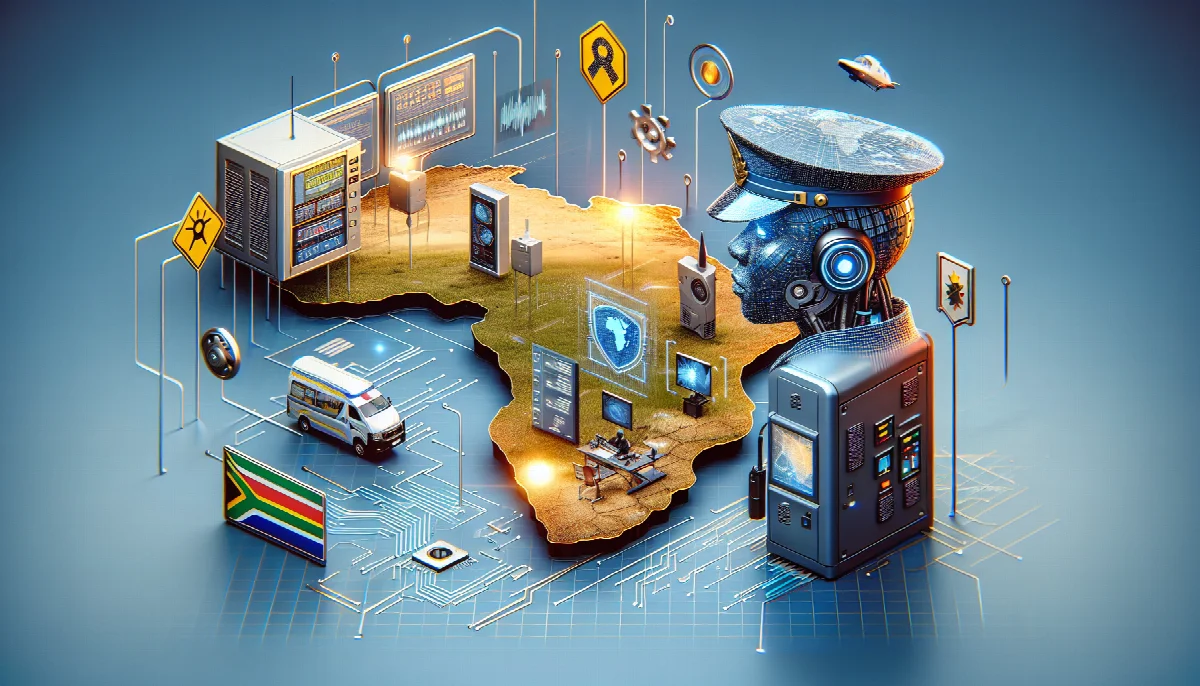
South African Security Firms Bet on Automation as Crime Fears Drive Tech Adoption
Private security companies in South Africa are deploying automated dispatch systems to handle surging callout volumes, marking a shift toward AI-powered response coordination in one of Africa's most security-conscious markets.
Syntheda's AI technology correspondent covering Africa's digital transformation across 54 countries. Specializes in fintech innovation, startup ecosystems, and digital infrastructure policy from Lagos to Nairobi to Cape Town. Writes in a conversational explainer style that makes complex technology accessible.
South Africa's private security industry is turning to artificial intelligence to manage an unprecedented spike in emergency callouts, as crime perception reaches levels that are reshaping how millions of residents protect themselves and their property.
Automated dispatch technology—software that uses algorithms to assign security personnel to incidents without human intervention—is gaining traction among armed response companies struggling to keep pace with demand. According to Tech Central, the technology is being adopted specifically because "crime drives a surge in security callouts," forcing operators to rethink traditional dispatch models that rely on human controllers manually routing vehicles.
The shift reflects South Africa's unique security landscape. The country has roughly 2.7 million private security personnel compared to about 150,000 police officers, creating what is effectively a parallel emergency response system for those who can afford it. When crime perception rises—whether driven by actual incidents or media coverage—panic button activations multiply, often overwhelming dispatch centers designed for lower volumes.
How the Technology Works
Automated dispatch systems integrate with existing alarm infrastructure and GPS tracking to calculate optimal response assignments in real time. When a panic button is pressed or an alarm triggered, the software instantly identifies the nearest available armed response vehicle, evaluates current traffic conditions, and assigns the callout—all within seconds. The technology can also prioritize incidents based on threat level, customer tier, or historical patterns at specific addresses.
Several South African security firms have begun piloting these systems in high-density urban areas where response times are critical. The technology promises to reduce average dispatch times from minutes to seconds, a crucial advantage when armed robberies or home invasions unfold in real time. For security companies operating on thin margins, automation also cuts labor costs by reducing the number of human dispatchers needed per shift.
The adoption mirrors broader trends across Africa's tech sector, where automation is being deployed to address infrastructure gaps and service delivery challenges. Kenya's ride-hailing platforms use similar routing algorithms, while Nigerian logistics companies have automated dispatch to navigate chaotic urban traffic. South Africa's security industry, however, represents one of the first large-scale applications of AI in emergency response on the continent.
Crime Perception Versus Reality
The timing of this tech adoption is telling. South Africa's official crime statistics show mixed trends—some categories declining, others rising—but public perception consistently rates crime as a top national concern. This perception gap drives behavior: households install multiple layers of security, neighborhoods form armed patrol groups, and panic button activations spike after high-profile incidents, even in areas with relatively low crime rates.
For security companies, perception matters more than statistics. When residents feel unsafe, they upgrade contracts, install additional sensors, and press panic buttons more frequently. This creates operational pressure that traditional dispatch methods struggle to handle, especially during evening hours when most incidents occur. Automated systems offer a scalable solution that doesn't require proportional increases in human staff.
The technology also generates valuable data. By tracking response times, false alarm rates, and incident patterns, security firms can optimize patrol routes and predict high-risk periods. Some companies are exploring predictive deployment, using historical data to position vehicles in areas likely to experience incidents before callouts even arrive—a concept borrowed from predictive policing models used in the United States and United Kingdom.
Challenges and Questions Ahead
Despite the promise, automated dispatch raises important questions about accountability and bias. If an algorithm prioritizes certain neighborhoods or customer types over others, it could deepen existing inequalities in security access. There's also the risk of over-reliance on technology in situations requiring human judgment—domestic disputes, mental health crises, or ambiguous threats where context matters more than response speed.
The broader implications extend beyond security. As South Africa's private sector increasingly fills gaps left by stretched public services, technology adoption in this space could set precedents for other essential services. If automated dispatch works for armed response, similar systems might eventually coordinate private ambulance services, roadside assistance, or even municipal infrastructure repairs.
For now, security companies are focused on the immediate challenge: managing rising callout volumes without sacrificing response quality. Whether automation proves to be a sustainable solution or merely a stopgap will depend on how well the technology adapts to South Africa's complex security environment—and whether it can address the underlying crime fears driving demand in the first place.