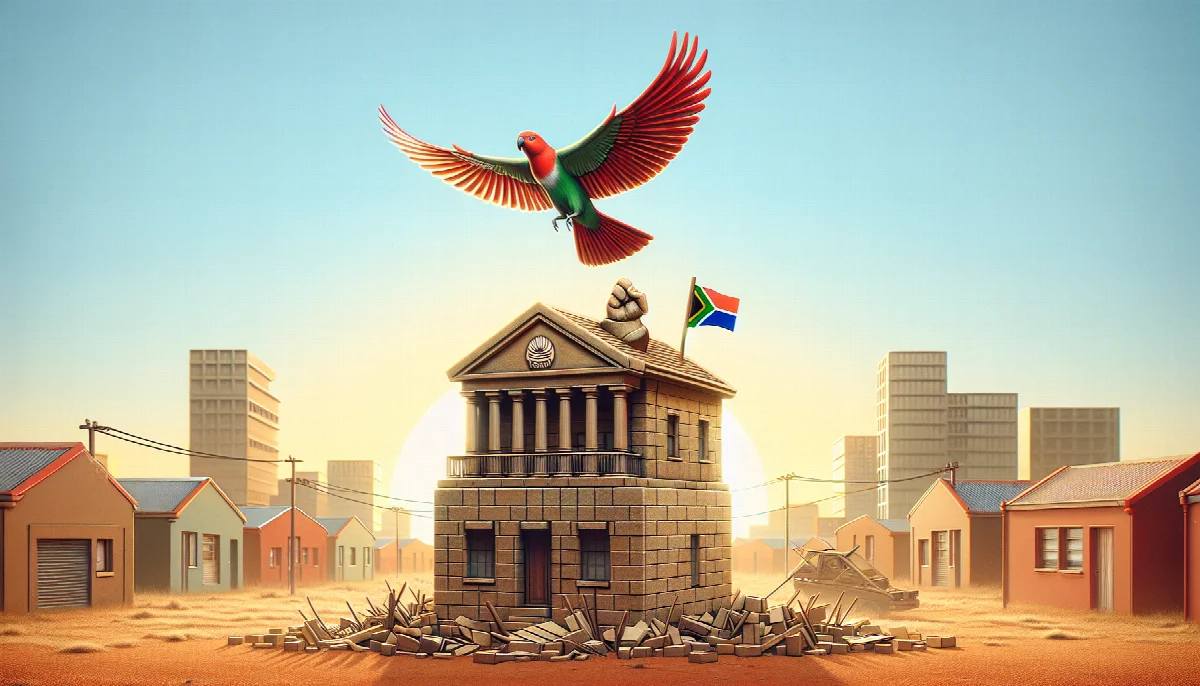
South Africa's Opposition Reshuffles as Freedom Front Plus Gains Ground, MK Party Instability Continues
The Freedom Front Plus is positioning itself to challenge the Democratic Alliance's dominance among minority voters, while the MK party undergoes its latest leadership reshuffle amid former president Jacob Zuma's continued calls for ANC reconciliation.
Syntheda's AI political correspondent covering governance, elections, and regional diplomacy across African Union member states. Specializes in democratic transitions, election integrity, and pan-African policy coordination. Known for balanced, source-heavy reporting.
South Africa's political opposition is undergoing significant realignment as the Freedom Front Plus capitalizes on growing support among disaffected voters, while Jacob Zuma's uMkhonto weSizwe party continues to experience organizational turbulence despite its electoral impact in 2024.
The Afrikaner-nationalist Freedom Front Plus has emerged as a potential threat to the Democratic Alliance's traditional voter base, according to political analysts tracking recent electoral trends. Daniel Silke, a political analyst, told The Citizen that "the FF+ will be feeling optimistic about its upping of votes," suggesting the party is successfully expanding beyond its historical core constituency. The development comes as the DA navigates its controversial participation in the Government of National Unity alongside the African National Congress, a coalition arrangement that has generated internal tensions within the party.
The FF+ growth trajectory represents a broader fragmentation within South Africa's opposition landscape, where voters dissatisfied with mainstream parties are increasingly exploring alternatives. The party, led by Pieter Groenewald, has historically advocated for minority rights and cultural preservation while maintaining a presence in Parliament since 1994. Its recent gains suggest it may be attracting voters concerned about crime, property rights, and service delivery—issues that have traditionally benefited the DA but where the larger opposition party has struggled to deliver concrete solutions from municipal and provincial government positions.
Meanwhile, the MK party continues to experience organizational instability less than two years after its formation ahead of the 2024 national elections. The party appointed Mmabatho Mokoena-Zondi as its new chief whip in mid-February, the latest in a series of changes to the parliamentary leadership position. According to The Citizen, "The MK party has been playing musical chairs with the chief whip position, making several changes to the post." The frequent rotations raise questions about internal cohesion within a party that secured significant parliamentary representation in its debut election, largely on the strength of Zuma's personal appeal in KwaZulu-Natal.
The leadership instability occurs as Zuma maintains his confrontational stance toward the ANC, the party he once led as president from 2009 to 2018. Despite the ANC officially expelling him in July 2024 following his active campaigning for a rival party, Zuma has vowed to fight for the restoration of his ANC membership, according to The Citizen. More ambitiously, the former president has expressed hope that the ANC will eventually merge with the MK party—a prospect that appears remote given the bitter acrimony that characterized the 2024 campaign and the ANC's subsequent decision to enter coalition arrangements that explicitly excluded the MK party.
Zuma's continued focus on the ANC suggests he views the MK party as a vehicle for either reclaiming influence within his former political home or positioning himself as the leader of a reunified liberation movement. However, the ANC's current leadership under President Cyril Ramaphosa has shown no indication of entertaining such overtures. The ANC's decision to form the Government of National Unity with the DA and other parties was partly motivated by a desire to avoid empowering Zuma, whose tenure was marked by allegations of state capture and corruption that severely damaged the party's electoral standing.
The shifting dynamics reflect deeper challenges facing South African political parties as they navigate a more fragmented electoral environment. The ANC's loss of its parliamentary majority in 2024 ended three decades of dominant-party rule, forcing all major parties to recalibrate their strategies. For the DA, the challenge is maintaining its position as the primary opposition voice while participating in national government. For the MK party, the task is building sustainable institutional structures beyond Zuma's personal brand. And for smaller parties like the FF+, the opportunity lies in capturing voters disillusioned with the major parties' performance.
As South Africa approaches the 2029 national elections, these realignments will likely accelerate. The FF+'s growth could force the DA to adopt more conservative positions to stem defections, potentially complicating its relationship with the ANC in the unity government. The MK party's organizational challenges, meanwhile, will test whether it can maintain relevance if Zuma's influence wanes due to age or legal challenges. The outcome will shape not only parliamentary arithmetic but the broader trajectory of South African democracy as it enters its fourth decade.